JEE Main 2025 January Physics: Dual Nature of Radiation & Matter – Previous Year Questions
All 12 questions asked from Dual Nature of Radiation & Matter in JEE Main 2025 January Physics (22, 23, 24, 28 and 29 January, all shifts). This chapter is about 4.8% of the 250 Physics questions in the session: 11 single-correct (MCQ) and 1 numerical-value questions. Select an answer to attempt each question, and open “View solution” under it.
12questions
11MCQ
1numerical
4.8%of Physics paper
Topics asked in this chapter
Photoelectric Effect – 7 questions
de Broglie Waves – 5 questions
Photoelectric Effect
Q122 Jan 2025 · Shift 1MCQ
The work functions of cesium (Cs) and lithium (Li) metals are 1.9 eV and 2.5 eV, respectively. If we incident a light of wavelength 550 nm on these two metal surfaces, then photo-electric effect is possible for the case of
A
Li only
B
Neither Cs nor Li
C
Both Cs and Li
D
Cs only
Q222 Jan 2025 · Shift 2MCQ
A light source of wavelength $\lambda$ illuminates a metal surface and electrons are ejected with maximum kinetic energy of 2 eV. If the same surface is illuminated by a light source of wavelength $\frac{\lambda}{2}$, then the maximum kinetic energy of ejected electrons will be (The work function of metal is 1 eV)
A
6 eV
B
3 eV
C
5 eV
D
2 eV
Q323 Jan 2025 · Shift 2MCQ
In photoelectric effect, an em-wave is incident on a metal surface and electrons are ejected from the surface. If the work function of the metal is 2.14 eV and stopping potential is 2 V, what is the wavelength of the em-wave? (Given $hc = 1242$ eV nm where $h$ is the Planck's constant and $c$ is the speed of light in vacuum.)
A
400 nm
B
200 nm
C
600 nm
D
300 nm
Q424 Jan 2025 · Shift 2MCQ
In photoelectric effect, the stopping potential ($V_0$) v/s frequency ($\nu$) curve is plotted. ($h$ is the Planck's constant and $\phi_0$ is work function of metal)
(A) $V_0$ v/s $\nu$ is linear.
(B) The slope of $V_0$ v/s $\nu$ curve $= \dfrac{\phi_0}{h}$
(C) $h$ constant is related to the slope of $V_0$ v/s $\nu$ line.
(D) The value of electric charge of electron is not required to determine $h$ using the $V_0$ v/s $\nu$ curve.
(E) The work function can be estimated without knowing the value of $h$.
Choose the correct answer from the options given below :
A
(D) and (E) only
B
(A), (B) and (C) only
C
(A), (C) and (E) only
D
(C) and (D) only
Q524 Jan 2025 · Shift 2Numerical
The ratio of the power of a light source $S_1$ to that the light source $S_2$ is 2. $S_1$ is emitting $2\times10^{15}$ photons per second at 600 nm. If the wavelength of the source $S_2$ is 300 nm, then the number of photons per second emitted by $S_2$ is $\times10^{14}$.
Q629 Jan 2025 · Shift 1MCQ
Given below are two statements : one is labelled as Assertion (A) and the other is labelled as Reason (R).
Assertion (A) : Emission of electrons in photoelectric effect can be suppressed by applying a sufficiently negative electron potential to the photoemissive substance.
Reason (R) : A negative electric potential, which stops the emission of electrons from the surface of a photoemissive substance, varies linearly with frequency of incident radiation.
In the light of the above statements, choose the most appropriate answer from the options given below :
A
Both (A) and (R) are true and (R) is the correct explanation of (A)
B
(A) is true but (R) is false
C
(A) is false but (R) is true
D
Both (A) and (R) are true but (R) is not the correct explanation of (A)
Q729 Jan 2025 · Shift 2MCQ
In an experiment with photoelectric effect, the stopping potential,
A
is $\left(\frac{1}{e}\right)$ times the maximum kinetic energy of the emitted photoelectrons
B
decreases with increase in the intensity of the incident light
C
increases with increase in the wavelength of the incident light
D
increases with increase in the intensity of the incident light
de Broglie Waves
Q823 Jan 2025 · Shift 1MCQ
A sub-atomic particle of mass $10^{-30}$ kg is moving with a velocity $2.21\times10^{6}$ m/s. Under the matter wave consideration, the particle will behave closely like . ($h = 6.63\times10^{-34}$ J.s)
A
Infra-red radiation
B
Gamma rays
C
X-rays
D
Visible radiation
Q924 Jan 2025 · Shift 1MCQ
An electron of mass ‘$m$’ with an initial velocity $\vec v = v_0\hat i$ ($v_0>0$) enters an electric field $\vec E = -E_0\hat k$. If the initial de Broglie wavelength is $\lambda_0$, the value after time $t$ would be
A proton of mass ‘$m_p$’ has same energy as that of a photon of wavelength ‘$\lambda$’. If the proton is moving at non-relativistic speed, then ratio of its de Broglie wavelength to the wavelength of photon is.
A
$\dfrac1c\sqrt{\dfrac{E}{2m_p}}$
B
$\dfrac1c\sqrt{\dfrac{2E}{m_p}}$
C
$\dfrac1c\sqrt{\dfrac{E}{m_p}}$
D
$\dfrac1{2c}\sqrt{\dfrac{E}{m_p}}$
Q1128 Jan 2025 · Shift 2MCQ
Which of the following phenomena can not be explained by wave theory of light ?
A
Refraction of light
B
Compton effect
C
Reflection of light
D
Diffraction of light
Q1229 Jan 2025 · Shift 1MCQ
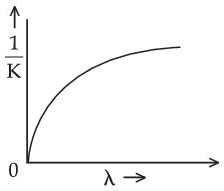
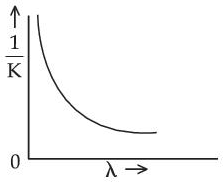
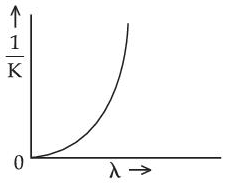
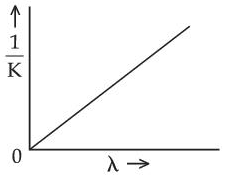
If $\lambda$ and $K$ are de Broglie wavelength and kinetic energy, respectively, of a particle with constant mass. The correct graphical representation for the particle will be