JEE Main 2025 January Physics: Wave Optics – Previous Year Questions

All 9 questions asked from Wave Optics in JEE Main 2025 January Physics (22, 23, 24, 28 and 29 January, all shifts). This chapter is about 3.6% of the 250 Physics questions in the session: 7 single-correct (MCQ) and 2 numerical-value questions. Select an answer to attempt each question, and open “View solution” under it.

9questions
7MCQ
2numerical
3.6%of Physics paper

Topics asked in this chapter

  • Polarisation – 1 question
  • Thin Film Interference – 2 questions
  • Young's Double Slit Experiment – 6 questions

Polarisation

Q124 Jan 2025 · Shift 2MCQ
In a Young's double slit experiment, three polarizers are kept as shown in the figure. The transmission axes of $P_1$ and $P_2$ are orthogonal to each other. The polarizer $P_3$ covers both the slits with its transmission axis at $45^\circ$ to those of $P_1$ and $P_2$. An unpolarized light of wavelength $\lambda$ and intensity $I_0$ is incident on $P_1$ and $P_2$. The intensity at a point after $P_3$ where the path difference between the light waves from $s_1$ and $s_2$ is $\frac{\lambda}{3}$, is
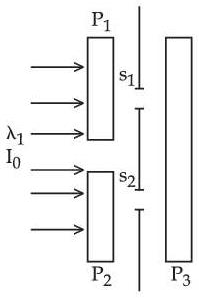
Figure for the question
  1. A
    $\dfrac{I_0}{4}$
  2. B
    $\dfrac{I_0}{2}$
  3. C
    $I_0$
  4. D
    $\dfrac{I_0}{3}$

Thin Film Interference

Q222 Jan 2025 · Shift 2MCQ
A transparent film of refractive index, $2.0$ is coated on a glass slab of refractive index, $1.45$. What is the minimum thickness of transparent film to be coated for the maximum transmission of Green light of wavelength $550$ nm. [Assume that the light is incident nearly perpendicular to the glass surface.]
  1. A
    94.8 nm
  2. B
    275 nm
  3. C
    137.5 nm
  4. D
    68.7 nm
Q328 Jan 2025 · Shift 2Numerical
A thin transparent film with refractive index $1.4$, is held on circular ring of radius $1.8$ cm. The fluid in the film evaporates such that transmission through the film at wavelength $560$ nm goes to a minimum every $12$ seconds. Assuming that the film is flat on its two sides, the rate of evaporation is $\pi\times10^{-13}$ m$^3$/s.

Young's Double Slit Experiment

Q422 Jan 2025 · Shift 1MCQ
Given below are two statements : one is labelled as Assertion (A) and the other is labelled as Reason (R).
Assertion-(A) : If Young's double slit experiment is performed in an optically denser medium than air, then the consecutive fringes come closer.
Reason-(R) : The speed of light reduces in an optically denser medium than air while its frequency does not change.
In the light of the above statements, choose the most appropriate answer from the options given below :
  1. A
    Both (A) and (R) are true and (R) is the correct explanation of (A)
  2. B
    (A) is true but (R) is false
  3. C
    (A) is false but (R) is true
  4. D
    Both (A) and (R) are true but (R) is not the correct explanation of (A)
Q522 Jan 2025 · Shift 2MCQ
Given below are two statements. One is labelled as Assertion (A) and the other is labelled as Reason (R).
Assertion (A) : In Young's double slit experiment, the fringes produced by red light are closer as compared to those produced by blue light.
Reason (R) : The fringe width is directly proportional to the wavelength of light.
In the light of the above statements, choose the correct answer from the options given below :
  1. A
    (A) is true but (R) is false
  2. B
    Both (A) and (R) are true and (R) is the correct explanation of (A)
  3. C
    (A) is false but (R) is true
  4. D
    Both (A) and (R) are true but (R) is NOT the correct explanation of (A)
Q623 Jan 2025 · Shift 2MCQ
The width of one of the two slits in Young's double slit experiment is $d$ while that of the other slit is $xd$. If the ratio of the maximum to the minimum intensity in the interference pattern on the screen is $9:4$ then what is the value of $x$ ? (Assume that the field strength varies according to the slit width.)
  1. A
    4
  2. B
    5
  3. C
    3
  4. D
    2
Q724 Jan 2025 · Shift 1MCQ
The Young's double slit interference experiment is performed using light consisting of $480$ nm and $600$ nm wavelengths to form interference patterns. The least number of the bright fringes of $480$ nm light that are required for the first coincidence with the bright fringes formed by $600$ nm light is
  1. A
    5
  2. B
    6
  3. C
    4
  4. D
    8
Q824 Jan 2025 · Shift 2MCQ
Young's double slit interference apparatus is immersed in a liquid of refractive index $1.44$. It has slit separation of $1.5$ mm. The slits are illuminated by a parallel beam of light whose wavelength in air is $690$ nm. The fringe-width on a screen placed behind the plane of slits at a distance of $0.72$ m, will be :
  1. A
    0.46 mm
  2. B
    0.63 mm
  3. C
    0.33 mm
  4. D
    0.23 mm
Q928 Jan 2025 · Shift 1Numerical
A double slit interference experiment performed with a light of wavelength $600$ nm forms an interference fringe pattern on a screen with $10^{\text{th}}$ bright fringe having its centre at a distance of $10$ mm from the central maximum. Distance of the centre of the $10^{\text{th}}$ bright fringe from the central maximum when the source of light is replaced by another source of wavelength $660$ nm would be mm.