JEE Main 2025 January Physics: Electrostatics – Previous Year Questions
All 17 questions asked from Electrostatics in JEE Main 2025 January Physics (22, 23, 24, 28 and 29 January, all shifts). This chapter is about 6.8% of the 250 Physics questions in the session: 14 single-correct (MCQ) and 3 numerical-value questions. Select an answer to attempt each question, and open “View solution” under it.
17questions
14MCQ
3numerical
6.8%of Physics paper
Topics asked in this chapter
Coulomb's Law & Electric Field – 5 questions
Electric Dipole – 6 questions
Electric Potential & Potential Energy – 3 questions
Gauss's Law & Electric Flux – 3 questions
Coulomb's Law & Electric Field
Q122 Jan 2025 · Shift 1MCQ
An electron is made to enter symmetrically between two parallel and equally but oppositely charged metal plates, each of 10 cm length. The electron emerges out of the electric field region with a horizontal component of velocity $10^6$ m/s. If the magnitude of the electric field between the plates is 9.1 V/cm, then the vertical component of velocity of electron is (mass of electron $= 9.1\times10^{-31}$ kg and charge $= 1.6\times10^{-19}$ C)
A
$16\times10^{6}$ m/s
B
0
C
$16\times10^{4}$ m/s
D
$1\times10^{6}$ m/s
Q223 Jan 2025 · Shift 1Numerical
A positive ion A and a negative ion B has charges $6.67\times10^{-19}$ C and $9.6\times10^{-10}$ C, and masses $19.2\times10^{-27}$ kg and $9\times10^{-27}$ kg respectively. At an instant, the ions are separated by a certain distance $r$. At that instant the ratio of the magnitudes of electrostatic force to gravitational force is $P\times10^{-13}$, where the value of $P$ is . (Take $\frac{1}{4\pi\epsilon_0}=9\times10^{9}\,\mathrm{Nm^2C^{-2}}$ and universal gravitational constant as $6.67\times10^{-11}\,\mathrm{Nm^2kg^{-2}}$)
Q324 Jan 2025 · Shift 2MCQ
A small uncharged conducting sphere is placed in contact with an identical sphere but having $4\times10^{-8}$ C charge and then removed to a distance such that the force of repulsion between them is $9\times10^{-3}$ N. The distance between them is (Take $\frac{1}{4\pi\epsilon_0}$ as $9\times10^{9}$ in SI units) :
A
3 cm
B
1 cm
C
4 cm
D
2 cm
Q428 Jan 2025 · Shift 1MCQ
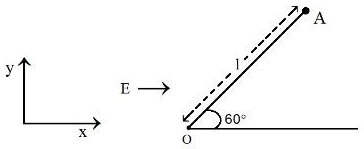
A particle of mass ‘$m$’ and charge ‘$q$’ is fastened to one end ‘A’ of a massless string having equilibrium length $l$, whose other end is fixed at point ‘O’. The whole system is placed on a frictionless horizontal plane and is initially at rest. If uniform electric field is switched on along the direction as shown in figure, then the speed of the particle when it crosses the x-axis is
A
$\sqrt{\frac{2qEl}{m}}$
B
$\sqrt{\frac{qEl}{m}}$
C
$\sqrt{\frac{qEl}{4m}}$
D
$\sqrt{\frac{qEl}{2m}}$
Q529 Jan 2025 · Shift 1MCQ
Match List - I with List - II.
{
List - I
List - II
(A)
Electric field inside (distance $r>0$ from center) of a uniformly charged spherical shell with surface charge density $\sigma$, and radius $R$.
(I)
$\sigma/\epsilon_0$
(B)
Electric field at distance $r>0$ from a uniformly charged infinite plane sheet with surface charge density $\sigma$.
(II)
$\sigma/2\epsilon_0$
(C)
Electric field outside (distance $r>0$ from center) of a uniformly charged spherical shell with surface charge density $\sigma$, and radius $R$.
(III)
$0$
(D)
Electric field between 2 oppositely charged infinite plane parallel sheets with uniform surface charge density $\sigma$.
(IV)
$\dfrac{\sigma}{\epsilon_0 r^2}$
} Choose the correct answer from the options given below :
A
(A)-(IV), (B)-(II), (C)-(III), (D)-(I)
B
(A)-(II), (B)-(I), (C)-(IV), (D)-(III)
C
(A)-(IV), (B)-(I), (C)-(III), (D)-(II)
D
(A)-(III), (B)-(II), (C)-(IV), (D)-(I)
Electric Dipole
Q622 Jan 2025 · Shift 2MCQ
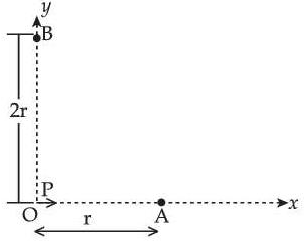
For a short dipole placed at origin O, the dipole moment $P$ is along $x$-axis, as shown in the figure. If the electric potential and electric field at A are $V_0$ and $E_0$, respectively, then the correct combination of the electric potential and electric field, respectively, at point B on the $y$-axis is given by
A
zero and $\frac{E_0}{16}$
B
$\frac{V_0}{2}$ and $\frac{E_0}{16}$
C
zero and $\frac{E_0}{8}$
D
$V_0$ and $\frac{E_0}{4}$
Q723 Jan 2025 · Shift 1MCQ
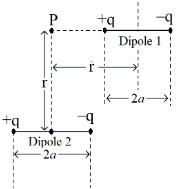
A point particle of charge $Q$ is located at P along the axis of an electric dipole 1 at a distance $r$ as shown in the figure. The point P is also on the equatorial plane of a second electric dipole 2 at a distance $r$. The dipoles are made of opposite charge $q$ separated by a distance $2a$. For the charge particle at P not to experience any net force, which of the following correctly describes the situation?
A
$\frac{a}{r}\sim 3$
B
$\frac{a}{r}\sim 20$
C
$\frac{a}{r}\sim 0.5$
D
$\frac{a}{r}\sim 10$
Q823 Jan 2025 · Shift 2MCQ
Two point charges $-4\ \mu$C and $4\ \mu$C, constituting an electric dipole, are placed at $(-9,0,0)$ cm and $(9,0,0)$ cm in a uniform electric field of strength $10^4\ \mathrm{NC^{-1}}$. The work done on the dipole in rotating it from the equilibrium through $180^\circ$ is :
A
16.4 mJ
B
12.4 mJ
C
18.4 mJ
D
14.4 mJ
Q928 Jan 2025 · Shift 2Numerical
An electric dipole of dipole moment $6\times10^{-6}$ Cm is placed in uniform electric field of magnitude $10^6$ V/m. Initially, the dipole moment is parallel to electric field. The work that needs to be done on the dipole to make its dipole moment opposite to the field, will be J.
Q1029 Jan 2025 · Shift 1MCQ
An electric dipole of mass $m$, charge $q$, and length $l$ is placed in a uniform electric field $\vec E=E_0\hat i$. When the dipole is rotated slightly from its equilibrium position and released, the time period of its oscillations will be :
A
$\frac{1}{2\pi}\sqrt{\frac{2m l}{qE_0}}$
B
$2\pi\sqrt{\frac{m l}{qE_0}}$
C
$2\pi\sqrt{\frac{m l}{2qE_0}}$
D
$\frac{1}{2\pi}\sqrt{\frac{m l}{2qE_0}}$
Q1129 Jan 2025 · Shift 2MCQ
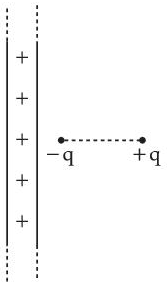
An electric dipole is placed at a distance of 2 cm from an infinite plane sheet having positive charge density $\sigma_0$. Choose the correct option from the following.
A
Potential energy and torque both are maximum.
B
Torque on dipole is zero and net force acts towards the sheet.
C
Potential energy of dipole is minimum and torque is zero.
D
Torque on dipole is zero and net force is directed away from the sheet.
Electric Potential & Potential Energy
Q1223 Jan 2025 · Shift 2MCQ
Two charges $7\ \mu$C and $-4\ \mu$C are placed at $(-7\text{ cm},0,0)$ and $(7\text{ cm},0,0)$ respectively. Given, $\epsilon_0=8.85\times10^{-12}\ \mathrm{C^2N^{-1}m^{-2}}$, the electrostatic potential energy of the charge configuration is :
A
$-1.2$ J
B
$-1.8$ J
C
$-1.5$ J
D
$-2.0$ J
Q1324 Jan 2025 · Shift 2MCQ
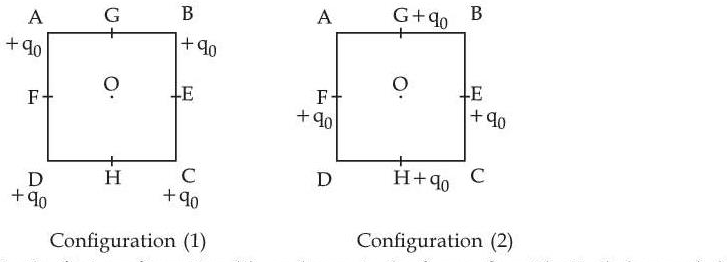
In the first configuration (1) as shown in the figure, four identical charges ($q_0$) are kept at the corners A, B, C and D of square of side length ‘a’. In the second configuration (2), the same charges are shifted to mid points G, E, H and F, of the square. If $K=\frac{1}{4\pi\epsilon_0}$, the difference between the potential energies of configuration (2) and (1) is given by :
A
$\frac{Kq_0^2}{a}\left(4\sqrt2-2\right)$
B
$\frac{Kq_0^2}{a}\left(3-\sqrt2\right)$
C
$\frac{Kq_0^2}{a}\left(3\sqrt2-2\right)$
D
$\frac{Kq_0^2}{a}\left(4-2\sqrt2\right)$
Q1428 Jan 2025 · Shift 1MCQ
Three infinitely long wires with linear charge density $\lambda$ are placed along the x-axis, y-axis and z-axis respectively. Which of the following denotes an equipotential surface?
A
$(x^2+y^2)(y^2+z^2)(z^2+x^2)=$ constant
B
$xy+yz+zx=$ constant
C
$(x+y)(y+z)(z+x)=$ constant
D
$xyz=$ constant
Gauss's Law & Electric Flux
Q1522 Jan 2025 · Shift 1MCQ
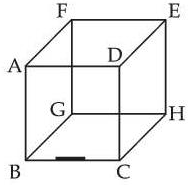
A line charge of length $\frac a2$ is kept at the center of an edge BC of a cube ABCDEFGH having edge length ‘a’ as shown in the figure. If the density of line charge is $\lambda$ C per unit length, then the total electric flux through all the faces of the cube will be . (Take, $\epsilon_0$ as the free space permittivity)
A
$\frac{\lambda a}{16\epsilon_0}$
B
$\frac{\lambda a}{2\epsilon_0}$
C
$\frac{\lambda a}{4\epsilon_0}$
D
$\frac{\lambda a}{8\epsilon_0}$
Q1624 Jan 2025 · Shift 1Numerical
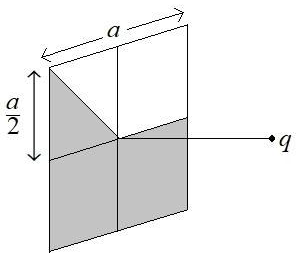
A square loop of sides $a=1$ m is held normally in front of a point charge $q=1$ C. The flux of the electric field through the shaded region is $\frac{5}{p}\times\frac{1}{\epsilon_0}\ \mathrm{\frac{Nm^2}{C}}$, where the value of $p$ is .
Q1729 Jan 2025 · Shift 2MCQ
A point charge causes an electric flux of $-2\times10^{4}\ \mathrm{Nm^2C^{-1}}$ to pass through a spherical Gaussian surface of 8.0 cm radius, centred on the charge. The value of the point charge is : (Given $\epsilon_0=8.85\times10^{-12}\ \mathrm{C^2N^{-1}m^{-2}}$)