JEE Main 2025 January Physics: Capacitors – Previous Year Questions

All 8 questions asked from Capacitors in JEE Main 2025 January Physics (22, 23, 24, 28 and 29 January, all shifts). This chapter is about 3.2% of the 250 Physics questions in the session: 7 single-correct (MCQ) and 1 numerical-value questions. Select an answer to attempt each question, and open “View solution” under it.

8questions
7MCQ
1numerical
3.2%of Physics paper

Topics asked in this chapter

  • Capacitors & Dielectrics – 8 questions

Capacitors & Dielectrics

Q122 Jan 2025 · Shift 1MCQ
A parallel-plate capacitor of capacitance 40 $\mu$F is connected to a 100 V power supply. Now the intermediate space between the plates is filled with a dielectric material of dielectric constant $K=2$. Due to the introduction of dielectric material, the extra charge and the change in the electrostatic energy in the capacitor, respectively, are
  1. A
    4 mC and 0.2 J
  2. B
    2 mC and 0.2 J
  3. C
    8 mC and 2.0 J
  4. D
    2 mC and 0.4 J
Q223 Jan 2025 · Shift 1MCQ
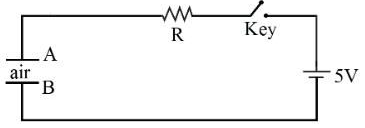
Identify the valid statements relevant to the given circuit at the instant when the key is closed.
A. There will be no current through resistor R.
B. There will be maximum current in the connecting wires.
C. Potential difference between the capacitor plates A and B is minimum.
D. Charge on the capacitor plates is minimum.
Choose the correct answer from the options given below:
Figure for the question
  1. A
    A, B, D Only
  2. B
    A, C Only
  3. C
    B, C, D Only
  4. D
    C, D Only
Q323 Jan 2025 · Shift 2Numerical
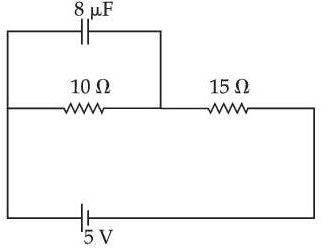
At steady state the charge on the capacitor, as shown in the circuit below, is $\mu$C.
Figure for the question
Q424 Jan 2025 · Shift 1MCQ
Consider a parallel plate capacitor of area A (of each plate) and separation ‘d’ between the plates. If E is the electric field and $\epsilon_0$ is the permittivity of free space between the plates, then potential energy stored in the capacitor is
  1. A
    $\frac12\epsilon_0E^2Ad$
  2. B
    $\epsilon_0E^2Ad$
  3. C
    $\frac34\epsilon_0E^2Ad$
  4. D
    $\frac14\epsilon_0E^2Ad$
Q524 Jan 2025 · Shift 1MCQ
A parallel plate capacitor was made with two rectangular plates, each with a length of $l=3$ cm and breath of $b=1$ cm. The distance between the plates is 3 $\mu$m. Out of the following, which are the ways to increase the capacitance by a factor of 10?
A. $l=30$ cm, $b=1$ cm, $d=1\ \mu$m
B. $l=3$ cm, $b=1$ cm, $d=30\ \mu$m
C. $l=6$ cm, $b=5$ cm, $d=3\ \mu$m
D. $l=1$ cm, $b=1$ cm, $d=10\ \mu$m
E. $l=5$ cm, $b=2$ cm, $d=1\ \mu$m
Choose the correct answer from the options given below:
  1. A
    C only
  2. B
    B and D only
  3. C
    A only
  4. D
    C and E only
Q628 Jan 2025 · Shift 1MCQ
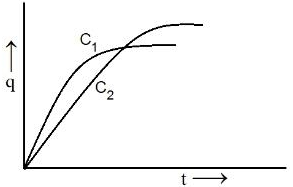
Two capacitors $C_1$ and $C_2$ are connected in parallel to a battery. Charge-time graph is shown below for the two capacitors. The energy stored with them are $U_1$ and $U_2$, respectively. Which of the given statements is true?
Figure for the question
  1. A
    $C_1>C_2,\ U_1<U_2$
  2. B
    $C_1>C_2,\ U_1>U_2$
  3. C
    $C_2>C_1,\ U_2>U_1$
  4. D
    $C_2>C_1,\ U_2<U_1$
Q728 Jan 2025 · Shift 2MCQ
A parallel plate capacitor of capacitance 1 $\mu$F is charged to a potential difference of 20 V. The distance between plates is 1 $\mu$m. The energy density between plates of capacitor is.
  1. A
    $2\times10^{2}\ \mathrm{J/m^3}$
  2. B
    $1.8\times10^{3}\ \mathrm{J/m^3}$
  3. C
    $2\times10^{-4}\ \mathrm{J/m^3}$
  4. D
    $1.8\times10^{5}\ \mathrm{J/m^3}$
Q829 Jan 2025 · Shift 2MCQ
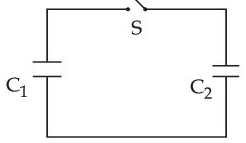
A capacitor, $C_1=6\ \mu$F is charged to a potential difference of $V_0=5$ V using a 5 V battery. The battery is removed and another capacitor, $C_2=12\ \mu$F is inserted in place of the battery. When the switch ‘S’ is closed, the charge flows between the capacitors for some time until equilibrium condition is reached. What are the charges ($q_1$ and $q_2$) on the capacitors $C_1$ and $C_2$ when equilibrium condition is reached.
Figure for the question
  1. A
    $q_1=20\ \mu$C, $q_2=10\ \mu$C
  2. B
    $q_1=15\ \mu$C, $q_2=30\ \mu$C
  3. C
    $q_1=10\ \mu$C, $q_2=20\ \mu$C
  4. D
    $q_1=30\ \mu$C, $q_2=15\ \mu$C