JEE Main 2025 January Physics: Kinematics – Previous Year Questions
All 9 questions asked from Kinematics in JEE Main 2025 January Physics (22, 23, 24, 28 and 29 January, all shifts). This chapter is about 3.6% of the 250 Physics questions in the session: 5 single-correct (MCQ) and 4 numerical-value questions. Select an answer to attempt each question, and open “View solution” under it.
9questions
5MCQ
4numerical
3.6%of Physics paper
Topics asked in this chapter
Graphs of Motion – 2 questions
Projectile Motion – 3 questions
Vectors & Relative Motion – 4 questions
Graphs of Motion
Q123 Jan 2025 · Shift 1MCQ
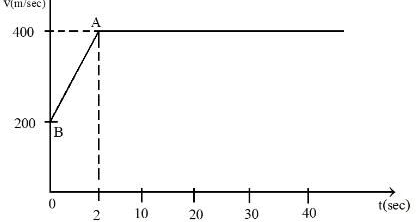
The motion of an airplane is represented by velocity-time graph as shown below. The distance covered by airplane in the first 30.5 second is km.
A
6
B
9
C
3
D
12
Q228 Jan 2025 · Shift 2MCQ
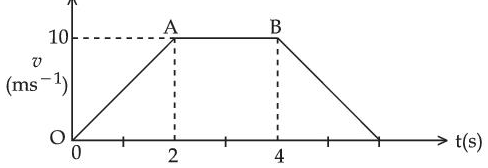
The velocity-time graph of an object moving along a straight line is shown in figure. What is the distance covered by the object between $t=0$ to $t=4$ s ?
A
10 m
B
30 m
C
13 m
D
11 m
Projectile Motion
Q322 Jan 2025 · Shift 1Numerical
A particle is projected at an angle of $30^\circ$ from horizontal at a speed of 60 m/s. The height traversed by the particle in the first second is $h_0$ and height traversed in the last second, before it reaches the maximum height, is $h_1$. The ratio $h_0:h_1$ is . [Take, $g=10\ \mathrm{m/s^2}$]
Q423 Jan 2025 · Shift 2MCQ
A ball having kinetic energy KE, is projected at an angle of $60^\circ$ from the horizontal. What will be the kinetic energy of ball at the highest point of its flight ?
A
$\dfrac{KE}{16}$
B
$\dfrac{KE}{4}$
C
$\dfrac{KE}{2}$
D
$\dfrac{KE}{8}$
Q529 Jan 2025 · Shift 1MCQ
Two projectiles are fired with same initial speed from same point on ground at angles of $(45^\circ-\alpha)$ and $(45^\circ+\alpha)$, respectively, with the horizontal direction. The ratio of their maximum heights attained is :
A
$\dfrac{1-\tan\alpha}{1+\tan\alpha}$
B
$\dfrac{1-\sin2\alpha}{1+\sin2\alpha}$
C
$\dfrac{1+\sin\alpha}{1-\sin\alpha}$
D
$\dfrac{1+\sin2\alpha}{1-\sin2\alpha}$
Vectors & Relative Motion
Q623 Jan 2025 · Shift 1Numerical
Two particles are located at equal distance from origin. The position vectors of those are represented by $\vec A=2\hat i+3n\hat j+2\hat k$ and $\vec B=2\hat i-2\hat j+4p\hat k$, respectively. If both the vectors are at right angle to each other, the value of $n^{-1}$ is .
Q724 Jan 2025 · Shift 2MCQ
The position vector of a moving body at any instant of time is given as $\vec r=(5t^2\hat i-5t\hat j)$ m. The magnitude and direction of velocity at $t=2$ s is,
A
$5\sqrt{15}$ m/s, making an angle of $\tan^{-1}4$ with $-$ve Y axis
B
$5\sqrt{17}$ m/s, making an angle of $\tan^{-1}4$ with $+$ve X axis
C
$5\sqrt{15}$ m/s, making an angle of $\tan^{-1}4$ with $+$ve X axis
D
$5\sqrt{17}$ m/s, making an angle of $\tan^{-1}4$ with $-$ve Y axis
Q829 Jan 2025 · Shift 1Numerical
The maximum speed of a boat in still water is 27 km/h. Now this boat is moving downstream in a river flowing at 9 km/h. A man in the boat throws a ball vertically upwards with speed of 10 m/s. Range of the ball as observed by an observer at rest on the river bank, is cm. (Take $g=10\ \mathrm{m/s^2}$)
Q929 Jan 2025 · Shift 2Numerical
Two cars P and Q are moving on a road in the same direction. Acceleration of car P increases linearly with time whereas car Q moves with a constant acceleration. Both cars cross each other at time $t=0$, for the first time. The maximum possible number of crossing(s) (including the crossing at $t=0$) is .