Home › JEE Main 2025 Jan Physics PYQ › Laws of Motion & Circular Motion

JEE Main 2025 January Physics: Laws of Motion & Circular Motion – Previous Year Questions

All 9 questions asked from Laws of Motion & Circular Motion in JEE Main 2025 January Physics (22, 23, 24, 28 and 29 January, all shifts). This chapter is about 3.6% of the 250 Physics questions in the session: 7 single-correct (MCQ) and 2 numerical-value questions. Select an answer to attempt each question, and open “View solution” under it.
9questions
7MCQ
2numerical
3.6%of Physics paper

Topics asked in this chapter

  • Newton's Laws & Friction – 2 questions
  • Circular Motion – 7 questions

Newton's Laws & Friction

Q123 Jan 2025 · Shift 2MCQ
A massless spring gets elongated by amount $x_1$ under a tension of 5 N. Its elongation is $x_2$ under the tension of 7 N. For the elongation of $(5x_1-2x_2)$, the tension in the spring will be
  1. A
    39 N
  2. B
    11 N
  3. C
    20 N
  4. D
    15 N
Q228 Jan 2025 · Shift 2MCQ
A balloon and its content having mass M is moving up with an acceleration ‘a’. The mass that must be released from the content so that the balloon starts moving up with an acceleration ‘3a’ will be (Take ‘g’ as acceleration due to gravity)
  1. A
    $\dfrac{3Ma}{2a+g}$
  2. B
    $\dfrac{3Ma}{2a-g}$
  3. C
    $\dfrac{2Ma}{3a+g}$
  4. D
    $\dfrac{2Ma}{3a-g}$

Circular Motion

Q322 Jan 2025 · Shift 1MCQ
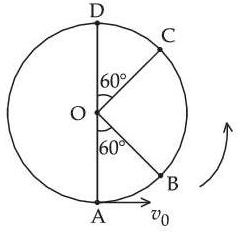
A bob of mass $m$ is suspended at a point O by a light string of length $l$ and left to perform vertical motion (circular) as shown in figure. Initially, by applying horizontal velocity $v_0$ at the point ‘A’, the string becomes slack when the bob reaches at the point ‘D’. The ratio of the kinetic energy of the bob at the points B and C is .
Figure for the question
  1. A
    3
  2. B
    2
  3. C
    1
  4. D
    4
Q422 Jan 2025 · Shift 2MCQ
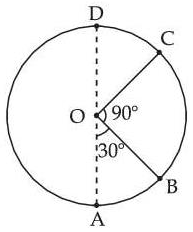
A body of mass 100 g is moving in circular path of radius 2 m on vertical plane as shown in figure. The velocity of the body at point A is 10 m/s. The ratio of its kinetic energies at point B and C is : (Take acceleration due to gravity as $10\ \mathrm{m/s^2}$)
Figure for the question
  1. A
    $\dfrac{3-\sqrt2}{2}$
  2. B
    $\dfrac{2+\sqrt2}{3}$
  3. C
    $\dfrac{2+\sqrt3}{3}$
  4. D
    $\dfrac{3+\sqrt3}{2}$
Q522 Jan 2025 · Shift 2Numerical
A tube of length 1 m is filled completely with an ideal liquid of mass $2M$, and closed at both ends. The tube is rotated uniformly in horizontal plane about one of its ends. If the force exerted by the liquid at the other end is $F$ then angular velocity of the tube is $\sqrt{\dfrac{F}{\alpha M}}$ in SI unit. The value of $\alpha$ is .
Q624 Jan 2025 · Shift 1MCQ
A car of mass ‘m’ moves on a banked road having radius ‘r’ and banking angle $\theta$. To avoid slipping from banked road, the maximum permissible speed of the car is $v_0$. The coefficient of friction $\mu$ between the wheels of the car and the banked road is
  1. A
    $\mu=\dfrac{v_0^2+rg\tan\theta}{rg-v_0^2\tan\theta}$
  2. B
    $\mu=\dfrac{v_0^2-rg\tan\theta}{rg+v_0^2\tan\theta}$
  3. C
    $\mu=\dfrac{v_0^2+rg\tan\theta}{rg+v_0^2\tan\theta}$
  4. D
    $\mu=\dfrac{v_0^2-rg\tan\theta}{rg-v_0^2\tan\theta}$
Q724 Jan 2025 · Shift 2Numerical
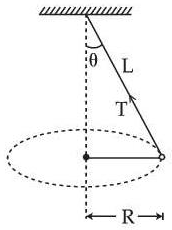
A string of length $L$ is fixed at one end and carries a mass of $M$ at the other end. The mass makes $\left(\dfrac{3}{\pi}\right)$ rotations per second about the vertical axis passing through end of the string as shown. The tension in the string is $ML$.
Figure for the question
Q828 Jan 2025 · Shift 1MCQ
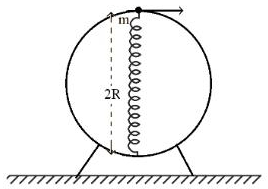
A bead of mass ‘m’ slides without friction on the wall of a vertical circular hoop of radius ‘R’ as shown in figure. The bead moves under the combined action of gravity and a massless spring (k) attached to the bottom of the hoop. The equilibrium length of the spring is ‘R’. If the bead is released from top of the hoop with (negligible) zero initial speed, velocity of bead, when length of spring becomes ‘R’, would be (spring constant is ‘k’, g is acceleration due to gravity)
Figure for the question
  1. A
    $\sqrt{2Rg+\dfrac{4kR^2}{m}}$
  2. B
    $\sqrt{2Rg+\dfrac{kR^2}{m}}$
  3. C
    $2\sqrt{gR+\dfrac{kR^2}{m}}$
  4. D
    $\sqrt{3Rg+\dfrac{kR^2}{m}}$
Q929 Jan 2025 · Shift 1MCQ
A body of mass ‘m’ connected to a massless and unstretchable string goes in vertical circle of radius ‘R’ under gravity $g$. The other end of the string is fixed at the center of circle. If velocity at top of circular path is $n\sqrt{gR}$, where, $n\ge1$, then ratio of kinetic energy of the body at bottom to that at top of the circle is
  1. A
    $\dfrac{n}{n+4}$
  2. B
    $\dfrac{n^2+4}{n^2}$
  3. C
    $\dfrac{n^2}{n^2+4}$
  4. D
    $\dfrac{n+4}{n}$