JEE Main 2025 January Physics: Magnetic Effects of Current & Magnetism – Previous Year Questions
All 14 questions asked from Magnetic Effects of Current & Magnetism in JEE Main 2025 January Physics (22, 23, 24, 28 and 29 January, all shifts). This chapter is about 5.6% of the 250 Physics questions in the session: 9 single-correct (MCQ) and 5 numerical-value questions. Select an answer to attempt each question, and open “View solution” under it.
14questions
9MCQ
5numerical
5.6%of Physics paper
Topics asked in this chapter
Magnetic Field due to Current – 8 questions
Magnetism & Matter (Bar Magnet) – 2 questions
Moving Charges in Magnetic Field – 3 questions
Moving Coil Galvanometer – 1 question
Magnetic Field due to Current
Q122 Jan 2025 · Shift 2Numerical
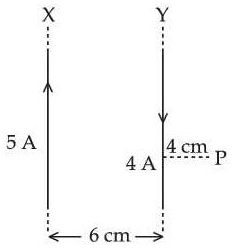
Two long parallel wires X and Y, separated by a distance of 6 cm, carry currents of 5 A and 4 A, respectively, in opposite directions as shown in the figure. Magnitude of the resultant magnetic field at point P at a distance of 4 cm from wire Y is $x \times 10^{-5}$ T. The value of $x$ is . Take permeability of free space as $\mu_0 = 4\pi \times 10^{-7}$ SI units.
Q224 Jan 2025 · Shift 1Numerical
A current of 5 A exists in a square loop of side $\frac{1}{\sqrt{2}}$ m. Then the magnitude of the magnetic field $B$ at the centre of the square loop will be $p \times 10^{-6}$ T, where value of $p$ is . [Take $\mu_0 = 4\pi \times 10^{-7}\ \mathrm{TmA^{-1}}$].
Q324 Jan 2025 · Shift 2MCQ
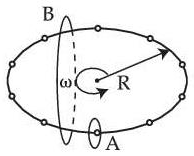
$N$ equally spaced charges each of value $q$, are placed on a circle of radius $R$. The circle rotates about its axis with an angular velocity $\omega$ as shown in the figure. A bigger Amperian loop B encloses the whole circle where as a smaller Amperian loop A encloses a small segment. The difference between enclosed currents, $I_A - I_B$, for the given Amperian loops is
A
$\frac{N}{\pi}q\omega$
B
$\frac{2\pi}{N}q\omega$
C
$\frac{N}{2\pi}q\omega$
D
$\frac{N^2}{2\pi}q\omega$
Q424 Jan 2025 · Shift 2MCQ
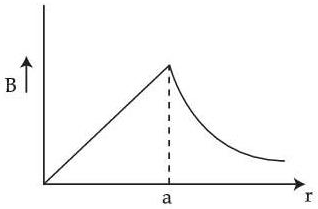
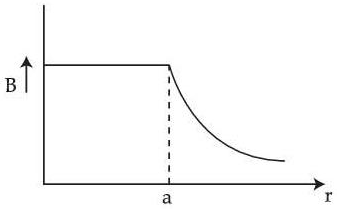
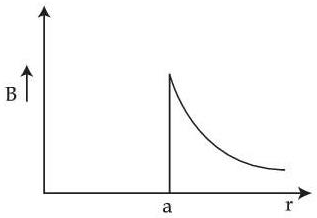
A long straight wire of a circular cross-section with radius ‘a’ carries a steady current $I$. The current $I$ is uniformly distributed across this cross-section. The plot of magnitude of magnetic field $B$ with distance $r$ from the centre of the wire is given by
A
B
C
D
Q524 Jan 2025 · Shift 2Numerical
A tightly wound long solenoid carries a current of 1.5 A. An electron is executing uniform circular motion inside the solenoid with a time period of 75 ns. The number of turns per metre in the solenoid is . [Take mass of electron $m_e = 9 \times 10^{-31}$ kg, charge of electron $|q_e| = 1.6 \times 10^{-19}$ C, $\mu_0 = 4\pi \times 10^{-7}\ \mathrm{N/A^2}$, 1 ns $= 10^{-9}$ s]
Q628 Jan 2025 · Shift 2MCQ
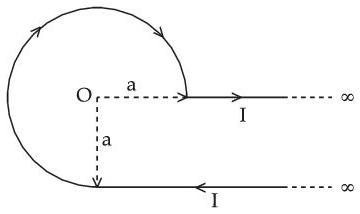
An infinite wire has a circular bend of radius $a$, and carrying a current $I$ as shown in figure. The magnitude of magnetic field at the origin O of the arc is given by :
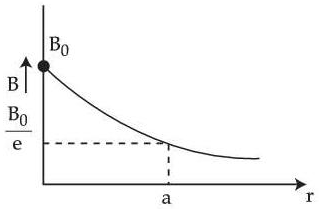
Consider a long straight wire of a circular cross-section (radius $a$) carrying a steady current $I$. The current is uniformly distributed across this cross-section. The distances from the centre of the wire's cross-section at which the magnetic field [inside the wire, outside the wire] is half of the maximum possible magnetic field, any where due to the wire, will be
A
$[a/2,\ 3a]$
B
$[a/4,\ 2a]$
C
$[a/4,\ 3a/2]$
D
$[a/2,\ 2a]$
Q829 Jan 2025 · Shift 2Numerical
The magnetic field inside a 200 turns solenoid of radius 10 cm is $2.9 \times 10^{-4}$ Tesla. If the solenoid carries a current of 0.29 A, then the length of the solenoid is $\pi$ cm.
Magnetism & Matter (Bar Magnet)
Q928 Jan 2025 · Shift 2MCQ
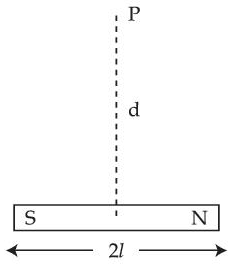
A bar magnet has total length $2l = 20$ units and the field point P is at a distance $d = 10$ units from the centre of the magnet. If the relative uncertainty of length measurement is 1%, then uncertainty of the magnetic field at point P is :
A
3%
B
5%
C
4%
D
10%
Q1029 Jan 2025 · Shift 2MCQ
Match List - I with List - II.
List - I
List - II
(A)
Magnetic induction
(I)
Ampere meter$^2$
(B)
Magnetic intensity
(II)
Weber
(C)
Magnetic flux
(III)
Gauss
(D)
Magnetic moment
(IV)
Ampere meter
Choose the correct answer from the options given below :
A
(A)-(III), (B)-(II), (C)-(I), (D)-(IV)
B
(A)-(I), (B)-(II), (C)-(III), (D)-(IV)
C
(A)-(III), (B)-(IV), (C)-(I), (D)-(II)
D
(A)-(III), (B)-(IV), (C)-(II), (D)-(I)
Moving Charges in Magnetic Field
Q1122 Jan 2025 · Shift 2Numerical
A proton is moving undeflected in a region of crossed electric and magnetic fields at a constant speed of $2 \times 10^{5}\ \mathrm{ms^{-1}}$. When the electric field is switched off, the proton moves along a circular path of radius 2 cm. The magnitude of electric field is $x \times 10^{4}$ N/C. The value of $x$ is . Take the mass of the proton $= 1.6 \times 10^{-27}$ kg.
Q1224 Jan 2025 · Shift 2MCQ
Given below are two statements. One is labelled as Assertion (A) and the other is labelled as Reason (R).
Assertion (A) : An electron in a certain region of uniform magnetic field is moving with constant velocity in a straight line path.
Reason (R) : The magnetic field in that region is along the direction of velocity of the electron.
In the light of the above statements, choose the correct answer from the options given below :
A
Both (A) and (R) are true but (R) is NOT the correct explanation of (A)
B
Both (A) and (R) are true and (R) is the correct explanation of (A)
C
(A) is true but (R) is false
D
(A) is false but (R) is true
Q1328 Jan 2025 · Shift 1MCQ
Consider a long thin conducting wire carrying a uniform current $I$. A particle having mass “$M$” and charge “$q$” is released at a distance “$a$” from the wire with a speed $v_0$ along the direction of current in the wire. The particle gets attracted to the wire due to magnetic force. The particle turns round when it is at distance $x$ from the wire. The value of $x$ is [$\mu_0$ is vacuum permeability]
A
$a\left[1-\frac{mv_0}{q\mu_0 I}\right]$
B
$\frac{a}{2}$
C
$a\left[1-\frac{mv_0}{2q\mu_0 I}\right]$
D
$a\,e^{-\frac{4\pi m v_0}{q\mu_0 I}}$
Moving Coil Galvanometer
Q1423 Jan 2025 · Shift 1MCQ
Consider a moving coil galvanometer (MCG):
A. The torsional constant in moving coil galvanometer has dimensions $[ML^2T^{-2}]$
B. Increasing the current sensitivity may not necessarily increase the voltage sensitivity.
C. If we increase number of turns ($N$) to its double ($2N$), then the voltage sensitivity doubles.
D. MCG can be converted into an ammeter by introducing a shunt resistance of large value in parallel with galvanometer.
E. Current sensitivity of MCG depends inversely on number of turns of coil.
Choose the correct answer from the options given below: