Home › JEE Main 2025 Jan Physics PYQ › Current Electricity

JEE Main 2025 January Physics: Current Electricity – Previous Year Questions

All 10 questions asked from Current Electricity in JEE Main 2025 January Physics (22, 23, 24, 28 and 29 January, all shifts). This chapter is about 4.0% of the 250 Physics questions in the session: 7 single-correct (MCQ) and 3 numerical-value questions. Select an answer to attempt each question, and open “View solution” under it.

10questions
7MCQ
3numerical
4.0%of Physics paper

Topics asked in this chapter

  • Cells, EMF & Internal Resistance – 1 question
  • Circuits & Kirchhoff's Laws – 3 questions
  • Meters & Potentiometer – 3 questions
  • Resistance & Resistivity – 3 questions

Cells, EMF & Internal Resistance

Q122 Jan 2025 · Shift 1MCQ
Given below are two statements :
Statement-I : The equivalent emf of two nonideal batteries connected in parallel is smaller than either of the two emfs.
Statement-II : The equivalent internal resistance of two nonideal batteries connected in parallel is smaller than the internal resistance of either of the two batteries.
In the light of the above statements, choose the correct answer from the options given below.
  1. A
    Both Statement-I and Statement-II are true
  2. B
    Both Statement-I and Statement-II are false
  3. C
    Statement-I is true but Statement-II is false
  4. D
    Statement-I is false but Statement-II is true
Circuits & Kirchhoff's Laws

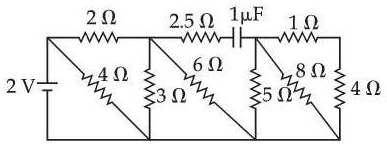
Q222 Jan 2025 · Shift 2Numerical
The net current flowing in the given circuit is A.
Figure for the question
Q328 Jan 2025 · Shift 1MCQ
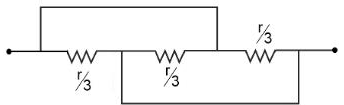
Find the equivalent resistance between two ends of the following circuit
Figure for the question
  1. A
    $\frac r6$
  2. B
    $\frac r9$
  3. C
    $r$
  4. D
    $\frac r3$
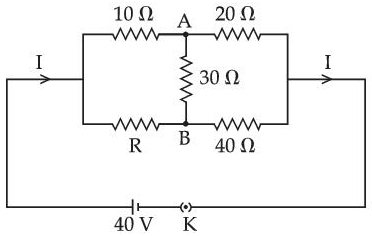
Q428 Jan 2025 · Shift 2Numerical
The value of current I in the electrical circuit as given below, when potential at A is equal to the potential at B, will be A.
Figure for the question

Meters & Potentiometer

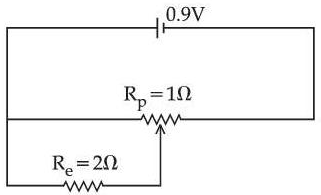
Q522 Jan 2025 · Shift 1MCQ
Sliding contact of a potentiometer is in the middle of the potentiometer wire having resistance $R_p=1\ \Omega$ as shown in the figure. An external resistance of $R_e=2\ \Omega$ is connected via the sliding contact. The electric current in the circuit is :
Figure for the question
  1. A
    0.9 A
  2. B
    1.0 A
  3. C
    0.3 A
  4. D
    1.35 A
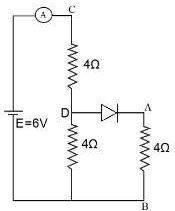
Q623 Jan 2025 · Shift 1MCQ
Refer to the circuit diagram given in the figure, which of the following observations are correct?
A. Total resistance of circuit is 6 $\Omega$.
B. Current in Ammeter is 1A
C. Potential across AB is 4 Volts.
D. Potential across CD is 4 Volts
E. Total resistance of the circuit is 8 $\Omega$.
Choose the correct answer from the options given below:
Figure for the question
  1. A
    A, C and D Only
  2. B
    A, B and C Only
  3. C
    B, C and E Only
  4. D
    A, B and D Only
Q723 Jan 2025 · Shift 2MCQ
A galvanometer having a coil of resistance 30 $\Omega$ need 20 mA of current for full-scale deflection. If a maximum current of 3 A is to be measured using this galvanometer, the resistance of the shunt to be added should be $\frac{30}{X}\ \Omega$, where $X$ is :
  1. A
    596
  2. B
    298
  3. C
    447
  4. D
    149

Resistance & Resistivity

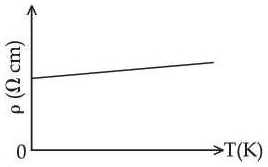
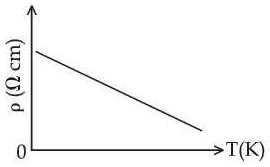
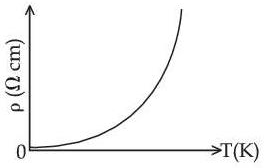
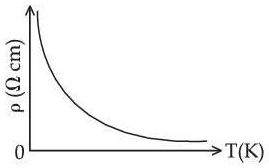
Q822 Jan 2025 · Shift 1MCQ
Which of the following resistivity ($\rho$) v/s temperature ($T$) curves is most suitable to be used in wire bound standard resistors ?
  1. A
    Figure for the question
  2. B
    Figure for the question
  3. C
    Figure for the question
  4. D
    Figure for the question
Q924 Jan 2025 · Shift 1Numerical
A wire of resistance 9 $\Omega$ is bent to form an equilateral triangle. Then the equivalent resistance across any two vertices will be ohm.
Q1028 Jan 2025 · Shift 1MCQ
A wire of resistance R is bent into a equilateral triangle and an identical wire is bent into a square. The ratio of resistance between the two end points of an edge of the triangle to that of the square is
  1. A
    27/32
  2. B
    32/27
  3. C
    9/8
  4. D
    8/9