JEE Main 2025 January Physics: Ray Optics – Previous Year Questions
All 23 questions asked from Ray Optics in JEE Main 2025 January Physics (22, 23, 24, 28 and 29 January, all shifts). This chapter is about 9.2% of the 250 Physics questions in the session: 21 single-correct (MCQ) and 2 numerical-value questions. Select an answer to attempt each question, and open “View solution” under it.
23questions
21MCQ
2numerical
9.2%of Physics paper
Topics asked in this chapter
Lenses – 10 questions
Mirrors – 4 questions
Prism & Dispersion – 2 questions
Refraction at Surfaces – 6 questions
Total Internal Reflection – 1 question
Lenses
Q122 Jan 2025 · Shift 1MCQ
Given is a thin convex lens of glass (refractive index $\mu$) and each side having radius of curvature $R$. One side is polished for complete reflection. At what distance from the lens, an object be placed on the optic axis so that the image gets formed on the object itself?
A
$\mu R$
B
$R/(2\mu-1)$
C
$R/(2\mu-3)$
D
$R/\mu$
Q222 Jan 2025 · Shift 1MCQ
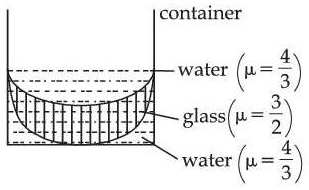
In the diagram given below, there are three lenses formed. Considering negligible thickness of each of them as compared to $|R_1|$ and $|R_2|$, i.e., the radii of curvature for upper and lower surfaces of the glass lens, the power of the combination is
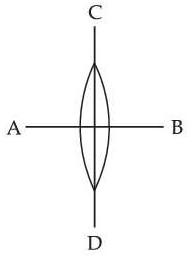
A symmetric thin biconvex lens is cut into four equal parts by two planes AB and CD as shown in figure. If the power of original lens is $4D$ then the power of a part of the divided lens is
A
$2D$
B
$4D$
C
$8D$
D
$D$
Q423 Jan 2025 · Shift 1MCQ
Given a thin convex lens (refractive index $\mu_2$), kept in a liquid (refractive index $\mu_1$, $\mu_1<\mu_2$) having radii of curvatures $|R_1|$ and $|R_2|$. Its second surface is silver polished. Where should an object be placed on the optic axis so that a real and inverted image is formed at the same place?
What is the relative decrease in focal length of a lens for an increase in optical power by $0.1\,$D from $2.5\,$D ? [‘D’ stands for dioptre]
A
0.04
B
0.1
C
0.01
D
0.40
Q624 Jan 2025 · Shift 1MCQ
A plano-convex lens having radius of curvature of first surface $2$ cm exhibits focal length of $f_1$ in air. Another plano-convex lens with first surface radius of curvature $3$ cm has focal length of $f_2$ when it is immersed in a liquid of refractive index $1.2$. If both the lenses are made of same glass of refractive index $1.5$, the ratio of $f_1$ and $f_2$ will be
A
$3:5$
B
$1:3$
C
$2:3$
D
$1:2$
Q724 Jan 2025 · Shift 2MCQ
A photograph of a landscape is captured by a drone camera at a height of $18$ km. The size of the camera film is $2\text{ cm}\times 2\text{ cm}$ and the area of the landscape photographed is $400\text{ km}^2$. The focal length of the lens in the drone camera is :
A
2.5 cm
B
1.8 cm
C
2.8 cm
D
0.9 cm
Q829 Jan 2025 · Shift 1MCQ
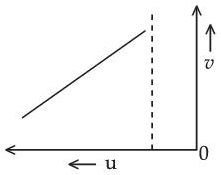
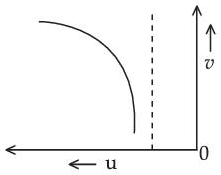
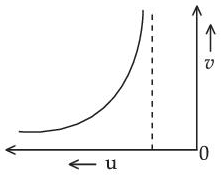
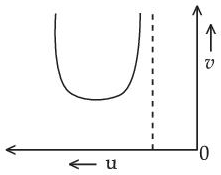
Let $u$ and $v$ be the distances of the object and the image from a lens of focal length $f$. The correct graphical representation of $u$ and $v$ for a convex lens when $|u|>f$, is
A
B
C
D
Q929 Jan 2025 · Shift 2MCQ
A convex lens made of glass (refractive index $=1.5$) has focal length $24$ cm in air. When it is totally immersed in water (refractive index $=1.33$), its focal length changes to
A
24 cm
B
72 cm
C
96 cm
D
48 cm
Q1029 Jan 2025 · Shift 2MCQ
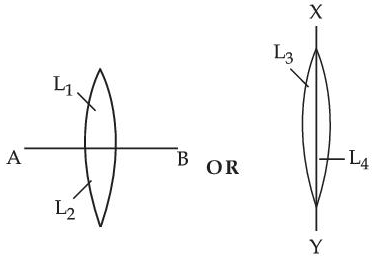
Two identical symmetric double convex lenses of focal length $f$ are cut into two equal parts $L_1,L_2$ by AB plane and $L_3,L_4$ by XY plane as shown in figure respectively. The ratio of focal lengths of lenses $L_1$ and $L_3$ is
A
$1:2$
B
$2:1$
C
$1:1$
D
$1:4$
Mirrors
Q1122 Jan 2025 · Shift 1Numerical
The driver sitting inside a parked car is watching vehicles approaching from behind with the help of his side view mirror, which is a convex mirror with radius of curvature $R=2$ m. Another car approaches him from behind with a uniform speed of $90$ km/hr. When the car is at a distance of $24$ m from him, the magnitude of the acceleration of the image of the car in the side view mirror is ‘a’. The value of $100a$ is m/s$^2$.
Q1223 Jan 2025 · Shift 2MCQ
A concave mirror of focal length $f$ in air is dipped in a liquid of refractive index $\mu$. Its focal length in the liquid will be :
A
$\dfrac{f}{\mu}$
B
$\dfrac{f}{(\mu-1)}$
C
$f$
D
$\mu f$
Q1324 Jan 2025 · Shift 1MCQ
A thin plano convex lens made of glass of refractive index $1.5$ is immersed in a liquid of refractive index $1.2$. When the plane side of the lens is silver coated for complete reflection, the lens immersed in the liquid behaves like a concave mirror of focal length $0.2$ m. The radius of curvature of the curved surface of the lens is
A
0.10 m
B
0.25 m
C
0.20 m
D
0.15 m
Q1428 Jan 2025 · Shift 2MCQ
A concave mirror produces an image of an object such that the distance between the object and image is $20$ cm. If the magnification of the image is ‘$-3$’, then the magnitude of the radius of curvature of the mirror is :
A
30 cm
B
7.5 cm
C
3.75 cm
D
15 cm
Prism & Dispersion
Q1523 Jan 2025 · Shift 2MCQ
The refractive index of the material of a glass prism is $\sqrt{3}$. The angle of minimum deviation is equal to the angle of the prism. What is the angle of the prism ?
A
$58^\circ$
B
$60^\circ$
C
$48^\circ$
D
$50^\circ$
Q1628 Jan 2025 · Shift 1MCQ
A thin prism $P_1$ with angle $4^\circ$ made of glass having refractive index $1.54$, is combined with another thin prism $P_2$ made of glass having refractive index $1.72$ to get dispersion without deviation. The angle of the prism $P_2$ in degrees is
A
$16/3$
B
4
C
1.5
D
3
Refraction at Surfaces
Q1723 Jan 2025 · Shift 1MCQ
A spherical surface of radius of curvature $R$, separates air from glass (refractive index $=1.5$). The centre of curvature is in the glass medium. A point object ‘O’ placed in air on the optic axis of the surface, so that its real image is formed at ‘I’ inside glass. The line OI intersects the spherical surface at P and $PO=PI$. The distance PO equals to
A
$3R$
B
$1.5R$
C
$2R$
D
$5R$
Q1823 Jan 2025 · Shift 1MCQ
What is the lateral shift of a ray refracted through a parallel-sided glass slab of thickness ‘h’ in terms of the angle of incidence ‘i’ and angle of refraction ‘r’, if the glass slab is placed in air medium?
A
$\dfrac{h\cos(i-r)}{\sin r}$
B
$h$
C
$\dfrac{h\tan(i-r)}{\tan r}$
D
$\dfrac{h\sin(i-r)}{\cos r}$
Q1928 Jan 2025 · Shift 1MCQ
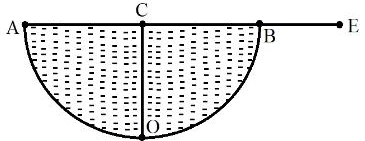
A hemispherical vessel is completely filled with a liquid of refractive index $\mu$. A small coin is kept at the lowest point (O) of the vessel as shown in figure. The minimum value of the refractive index of the liquid so that a person can see the coin from point E (at the level of the vessel) is .
A
$\sqrt{3}$
B
$\dfrac{3}{2}$
C
$\sqrt{2}$
D
$\dfrac{\sqrt{3}}{2}$
Q2028 Jan 2025 · Shift 2MCQ
In a long glass tube, mixture of two liquids A and B with refractive indices $1.3$ and $1.4$ respectively, forms a convex refractive meniscus towards A. If an object placed at $13$ cm from the vertex of the meniscus in A forms an image with a magnification of ‘$-2$’ then the radius of curvature of meniscus is :
A
$\dfrac{1}{3}$ cm
B
1 cm
C
$\dfrac{4}{3}$ cm
D
$\dfrac{2}{3}$ cm
Q2129 Jan 2025 · Shift 1Numerical
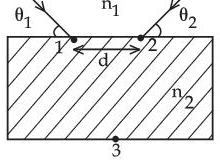
Two light beams fall on a transparent material block at point 1 and 2 with angle $\theta_1$ and $\theta_2$, respectively, as shown in figure. After refraction, the beams intersect at point 3 which is exactly on the interface at other end of the block. Given : the distance between 1 and 2, $d=4\sqrt{3}$ cm and $\theta_1=\theta_2=\cos^{-1}\left(\frac{n_2}{2n_1}\right)$, where refractive index of the block $n_2>$ refractive index of the outside medium $n_1$, then the thickness of the block is cm.
Q2229 Jan 2025 · Shift 2MCQ
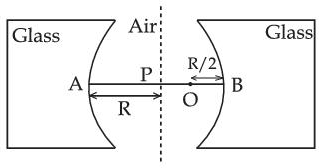
Two concave refracting surfaces of equal radii of curvature and refractive index $1.5$ face each other in air as shown in figure. A point object O is placed midway, between P and B. The separation between the images of O, formed by each refracting surface is :
A
$0.214R$
B
$0.411R$
C
$0.124R$
D
$0.114R$
Total Internal Reflection
Q2329 Jan 2025 · Shift 1MCQ
At the interface between two materials having refractive indices $n_1$ and $n_2$, the critical angle for reflection of an em wave is $\theta_{1C}$. The $n_2$ material is replaced by another material having refractive index $n_3$ such that the critical angle at the interface between $n_1$ and $n_3$ materials is $\theta_{2C}$. If $n_3>n_2>n_1$; $\frac{n_2}{n_3}=\frac{2}{5}$ and $\sin\theta_{2C}-\sin\theta_{1C}=\frac{1}{2}$, then $\theta_{1C}$ is