JEE Main 2025 January Physics: Gravitation – Previous Year Questions

All 10 questions asked from Gravitation in JEE Main 2025 January Physics (22, 23, 24, 28 and 29 January, all shifts). This chapter is about 4.0% of the 250 Physics questions in the session: 7 single-correct (MCQ) and 3 numerical-value questions. Select an answer to attempt each question, and open “View solution” under it.

10questions
7MCQ
3numerical
4.0%of Physics paper

Topics asked in this chapter

  • Gravitational Field & Acceleration due to Gravity – 3 questions
  • Satellites & Orbital Motion – 6 questions
  • Gravitational Interaction & Angular Momentum – 1 question

Gravitational Field & Acceleration due to Gravity

Q122 Jan 2025 · Shift 1MCQ
A small point of mass $m$ is placed at a distance $2R$ from the centre 'O' of a big uniform solid sphere of mass $M$ and radius $R$. The gravitational force on 'm' due to $M$ is $F_1$. A spherical part of radius $R/3$ is removed from the big sphere as shown in the figure and the gravitational force on $m$ due to remaining part of $M$ is found to be $F_2$. The value of ratio $F_1:F_2$ is
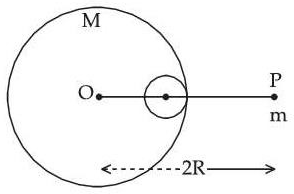
Figure for the question
  1. A
    11 : 10
  2. B
    16 : 9
  3. C
    12 : 9
  4. D
    12 : 11
Q224 Jan 2025 · Shift 2Numerical
Acceleration due to gravity on the surface of earth is 'g'. If the diameter of earth is reduced to one third of its original value and mass remains unchanged, then the acceleration due to gravity on the surface of the earth is $g$.
Q329 Jan 2025 · Shift 1MCQ
Given below are two statements : one is labelled as Assertion (A) and the other is labelled as Reason (R).
Assertion (A) : Time period of a simple pendulum is longer at the top of a mountain than that at the base of the mountain.
Reason (R) : Time period of a simple pendulum decreases with increasing value of acceleration due to gravity and vice-versa.
In the light of the above statements, choose the most appropriate answer from the options given below :
  1. A
    Both (A) and (R) are true and (R) is the correct explanation of (A)
  2. B
    Both (A) and (R) are true but (R) is not the correct explanation of (A)
  3. C
    (A) is true but (R) is false
  4. D
    (A) is false but (R) is true

Satellites & Orbital Motion

Q422 Jan 2025 · Shift 2MCQ
Given below are two statements. One is labelled as Assertion (A) and the other is labelled as Reason (R).
Assertion (A) : A simple pendulum is taken to a planet of mass and radius, 4 times and 2 times, respectively, than the Earth. The time period of the pendulum remains same on earth and the planet.
Reason (R) : The mass of the pendulum remains unchanged at Earth and the other planet.
In the light of the above statements, choose the correct answer from the options given below :
  1. A
    (A) is false but (R) is true
  2. B
    Both (A) and (R) are true but (R) is NOT the correct explanation of (A)
  3. C
    (A) is true but (R) is false
  4. D
    Both (A) and (R) are true and (R) is the correct explanation of (A)
Q523 Jan 2025 · Shift 2MCQ
If a satellite orbiting the Earth is 9 times closer to the Earth than the Moon, what is the time period of rotation of the satellite? Given rotational time period of Moon = 27 days and gravitational attraction between the satellite and the moon is neglected.
  1. A
    1 day
  2. B
    27 days
  3. C
    81 days
  4. D
    3 days
Q623 Jan 2025 · Shift 2Numerical
A satellite of mass $\frac{M}{2}$ is revolving around earth in a circular orbit at a height of $\frac{R}{3}$ from earth surface. The angular momentum of the satellite is $M\sqrt{\frac{GMR}{x}}$. The value of $x$ is , where $M$ and $R$ are the mass and radius of earth, respectively. ($G$ is the gravitational constant)
Q724 Jan 2025 · Shift 1MCQ
A satellite is launched into a circular orbit of radius 'R' around the earth. A second satellite is launched into an orbit of radius 1.03 R. The time period of revolution of the second satellite is larger than the first one approximately by
  1. A
    2.5%
  2. B
    4.5%
  3. C
    3%
  4. D
    9%
Q828 Jan 2025 · Shift 2MCQ
Earth has mass 8 times and radius 2 times that of a planet. If the escape velocity from the earth is 11.2 km/s, the escape velocity in km/s from the planet will be :
  1. A
    11.2
  2. B
    8.4
  3. C
    5.6
  4. D
    2.8
Q929 Jan 2025 · Shift 2Numerical
Two planets, A and B are orbiting a common star in circular orbits of radii $R_A$ and $R_B$, respectively, with $R_B=2R_A$. The planet B is $4\sqrt2$ times more massive than planet A. The ratio $\left(\frac{L_B}{L_A}\right)$ of angular momentum ($L_B$) of planet B to that of planet A($L_A$) is closest to integer .

Gravitational Interaction & Angular Momentum

Q1029 Jan 2025 · Shift 2MCQ
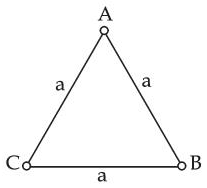
Three equal masses $m$ are kept at vertices (A, B, C) of an equilateral triangle of side $a$ in free space. At $t=0$, they are given an initial velocity $\vec V_A=V_0\,\overrightarrow{AC}$, $\vec V_B=V_0\,\overrightarrow{BA}$ and $\vec V_C=V_0\,\overrightarrow{CB}$. Here, $\overrightarrow{AC}$, $\overrightarrow{CB}$ and $\overrightarrow{BA}$ are unit vectors along the edges of the triangle. If the three masses interact gravitationally, then the magnitude of the net angular momentum of the system at the point of collision is :
Figure for the question
  1. A
    $3\,a\,m\,V_0$
  2. B
    $\frac{\sqrt3}{2}\,a\,m\,V_0$
  3. C
    $\frac12\,a\,m\,V_0$
  4. D
    $\frac32\,a\,m\,V_0$