JEE Main 2025 January Physics: Properties of Solids & Liquids – Previous Year Questions
All 15 questions asked from Properties of Solids & Liquids in JEE Main 2025 January Physics (22, 23, 24, 28 and 29 January, all shifts). This chapter is about 6.0% of the 250 Physics questions in the session: 10 single-correct (MCQ) and 5 numerical-value questions. Select an answer to attempt each question, and open “View solution” under it.
The increase in pressure required to decrease the volume of a water sample by 0.2% is $P\times10^{5}$ N m$^{-2}$. Bulk modulus of water is $2.15\times10^{9}$ N m$^{-2}$. The value of $P$ is .
Q228 Jan 2025 · Shift 2Numerical
The volume contraction of a solid copper cube of edge length 10 cm, when subjected to a hydraulic pressure of $7\times10^{6}$ Pa, would be mm$^3$. (Given bulk modulus of copper = $1.4\times10^{11}$ N m$^{-2}$)
Q329 Jan 2025 · Shift 1MCQ
The fractional compression $\left(\frac{\Delta V}{V}\right)$ of water at the depth of 2.5 km below the sea level is %. Given, the Bulk modulus of water = $2\times10^{9}$ N m$^{-2}$, density of water = $10^{3}$ kg m$^{-3}$, acceleration due to gravity = $g=10$ m s$^{-2}$.
A
1.75
B
1.25
C
1.5
D
1.0
Fluid Mechanics (Pressure, Buoyancy, Flow)
Q422 Jan 2025 · Shift 2MCQ
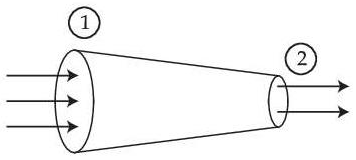
A tube of length $L$ is shown in the figure. The radius of cross section at the point (1) is 2 cm and at the point (2) is 1 cm, respectively. If the velocity of water entering at point (1) is 2 m/s, then velocity of water leaving the point (2) will be
A
2 m/s
B
4 m/s
C
6 m/s
D
8 m/s
Q523 Jan 2025 · Shift 2MCQ
Water flows in a horizontal pipe whose one end is closed with a valve. The reading of the pressure gauge attached to the pipe is $P_1$. The reading of the pressure gauge falls to $P_2$ when the valve is opened. The speed of water flowing in the pipe is proportional to
A
$P_1-P_2$
B
$\sqrt{P_1-P_2}$
C
$(P_1-P_2)^2$
D
$(P_1-P_2)^4$
Q628 Jan 2025 · Shift 2MCQ
A 400 g solid cube having an edge of length 10 cm floats in water. How much volume of the cube is outside the water ? (Given : density of water = 1000 kg m$^{-3}$)
A
600 cm$^3$
B
400 cm$^3$
C
4000 cm$^3$
D
1400 cm$^3$
Q729 Jan 2025 · Shift 1Numerical
In a hydraulic lift, the surface area of the input piston is 6 cm$^2$ and that of the output piston is 1500 cm$^2$. If 100 N force is applied to the input piston to raise the output piston by 20 cm, then the work done is kJ.
Surface Tension
Q822 Jan 2025 · Shift 1Numerical
Two soap bubbles of radius 2 cm and 4 cm, respectively, are in contact with each other. The radius of curvature of the common surface, in cm, is .
Q922 Jan 2025 · Shift 2MCQ
A small rigid spherical ball of mass $M$ is dropped in a long vertical tube containing glycerine. The velocity of the ball becomes constant after some time. If the density of glycerine is half of the density of the ball, then the viscous force acting on the ball will be (consider $g$ as acceleration due to gravity)
A
$Mg$
B
$\frac32Mg$
C
$2Mg$
D
$\frac{Mg}{2}$
Q1023 Jan 2025 · Shift 2Numerical
An air bubble of radius 1.0 mm is observed at a depth of 20 cm below the free surface of a liquid having surface tension 0.095 J/m$^2$ and density $10^3$ kg/m$^3$. The difference between pressure inside the bubble and atmospheric pressure is N/m$^2$. (Take $g=10$ m/s$^2$)
Q1124 Jan 2025 · Shift 1MCQ
An air bubble of radius 0.1 cm lies at a depth of 20 cm below the free surface of a liquid of density 1000 kg/m$^3$. If the pressure inside the bubble is 2100 N/m$^2$ greater than the atmospheric pressure, then the surface tension of the liquid in SI unit is (use $g=10$ m/s$^2$)
A
0.1
B
0.05
C
0.02
D
0.25
Q1224 Jan 2025 · Shift 1MCQ
The amount of work done to break a big water drop of radius 'R' into 27 small drops of equal radius is 10 J. The work done required to break the same big drop into 64 small drops of equal radius will be
A
20 J
B
15 J
C
5 J
D
10 J
Viscosity
Q1328 Jan 2025 · Shift 1MCQ
In the experiment for measurement of viscosity '$\eta$' of given liquid with a ball having radius R, consider following statements.
A. Graph between terminal velocity V and R will be a parabola.
B. The terminal velocities of different diameter balls are constant for a given liquid.
C. Measurement of terminal velocity is dependent on the temperature.
D. This experiment can be utilized to assess the density of a given liquid.
E. If balls are dropped with some initial speed, the value of $\eta$ will change.
Choose the correct answer from the options given below:
A
C, D and E Only
B
A, C and D Only
C
A, B and E Only
D
B, D and E Only
Surface Tension & Viscosity
Q1423 Jan 2025 · Shift 1MCQ
Given below are two statements:
Statement I: The hot water flows faster than cold water.
Statement II: Soap water has higher surface tension as compared to fresh water.
In the light above statements, choose the correct answer from the options given below
A
Both Statement I and Statement II are false
B
Statement I is false but Statement II is true
C
Both Statement I and Statement II are true
D
Statement I is true but Statement II is false
Q1528 Jan 2025 · Shift 1MCQ
Consider following statements:
A. Surface tension arises due to extra energy of the molecules at the interior as compared to the molecules at the surface, of a liquid.
B. As the temperature of liquid rises, the coefficient of viscosity increases.
C. As the temperature of gas increases, the coefficient of viscosity increases
D. The onset of turbulence is determined by Reynold's number.
E. In a steady flow two stream lines never intersect.
Choose the correct answer from the options given below: