JEE Main 2025 January Physics: Rotational Motion – Previous Year Questions
All 15 questions asked from Rotational Motion in JEE Main 2025 January Physics (22, 23, 24, 28 and 29 January, all shifts). This chapter is about 6.0% of the 250 Physics questions in the session: 11 single-correct (MCQ) and 4 numerical-value questions. Select an answer to attempt each question, and open “View solution” under it.
15questions
11MCQ
4numerical
6.0%of Physics paper
Topics asked in this chapter
Centre of Mass – 3 questions
Moment of Inertia – 2 questions
Torque & Angular Momentum – 7 questions
Rolling Motion – 3 questions
Centre of Mass
Q123 Jan 2025 · Shift 1MCQ
Consider a circular disc of radius 20 cm with centre located at the origin. A circular hole of radius 5 cm is cut from this disc in such a way that the edge of the hole touches the edge of the disc. The distance of centre of mass of residual or remaining disc from the origin will be
A
0.5 cm
B
2.0 cm
C
1.5 cm
D
1.0 cm
Q224 Jan 2025 · Shift 2MCQ
A solid sphere is rolling without slipping on a horizontal plane. The ratio of the linear kinetic energy of the centre of mass of the sphere and rotational kinetic energy is :
A
$\frac{2}{5}$
B
$\frac{3}{4}$
C
$\frac{4}{3}$
D
$\frac{5}{2}$
Q328 Jan 2025 · Shift 1MCQ
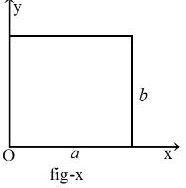
The center of mass of a thin rectangular plate (fig - x) with sides of length $a$ and $b$, whose mass per unit area ($\sigma$) varies as $\sigma=\frac{\sigma_0 x}{ab}$ (where $\sigma_0$ is a constant), would be .
A
$\left(\frac{2}{3}a,\frac{b}{2}\right)$
B
$\left(\frac{1}{3}a,\frac{b}{2}\right)$
C
$\left(\frac{a}{2},\frac{b}{2}\right)$
D
$\left(\frac{2}{3}a,\frac{2}{3}b\right)$
Moment of Inertia
Q422 Jan 2025 · Shift 1MCQ
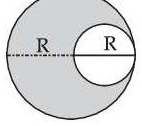
A uniform circular disc of radius 'R' and mass 'M' is rotating about an axis perpendicular to its plane and passing through its centre. A small circular part of radius R/2 is removed from the original disc as shown in the figure. Find the moment of inertia of the remaining part of the original disc about the axis as given above.
A
$\frac{9}{32}MR^2$
B
$\frac{13}{32}MR^2$
C
$\frac{17}{32}MR^2$
D
$\frac{7}{32}MR^2$
Q528 Jan 2025 · Shift 1Numerical
The moment of inertia of a solid disc rotating along its diameter is 2.5 times higher than the moment of inertia of a ring rotating in similar way. The moment of inertia of a solid sphere which has same radius as the disc and rotating in similar way, is $n$ times higher than the moment of inertia of the given ring. Here, $n=$ . Consider all the bodies have equal masses.
Torque & Angular Momentum
Q622 Jan 2025 · Shift 1Numerical
The position vectors of two 1 kg particles, (A) and (B), are given by $\vec r_A=(\alpha_1t^2\hat i+\alpha_2t\hat j+\alpha_3t\hat k)$ m and $\vec r_B=(\beta_1t\hat i+\beta_2t^2\hat j+\beta_3t\hat k)$ m, respectively; ($\alpha_1=1$ m/s$^2$, $\alpha_2=3n$ m/s, $\alpha_3=2$ m/s, $\beta_1=2$ m/s, $\beta_2=-1$ m/s$^2$, $\beta_3=4p$ m/s), where $t$ is time, $n$ and $p$ are constants. At $t=1$ s, $|\vec v_A|=|\vec v_B|$ and velocities $\vec v_A$ and $\vec v_B$ of the particles are orthogonal to each other. At $t=1$ s, the magnitude of angular momentum of particle (A) with respect to the position of particle (B) is $\sqrt{L}$ kg m$^2$ s$^{-1}$. The value of $L$ is .
Q722 Jan 2025 · Shift 2MCQ
The torque due to the force $(2\hat i+\hat j+2\hat k)$ about the origin, acting on a particle whose position vector is $(\hat i+\hat j+\hat k)$, would be
A
$\hat i-\hat j+\hat k$
B
$\hat j+\hat k$
C
$\hat i-\hat k$
D
$\hat i+\hat k$
Q823 Jan 2025 · Shift 2MCQ
A circular disk of radius $R$ meter and mass $M$ kg is rotating around the axis perpendicular to the disk. An external torque is applied to the disk such that $\theta(t)=5t^2-8t$, where $\theta(t)$ is the angular position of the rotating disc as a function of time $t$. How much power is delivered by the applied torque, when $t=2$ s ?
A
$72\,MR^2$
B
$8\,MR^2$
C
$108\,MR^2$
D
$60\,MR^2$
Q924 Jan 2025 · Shift 1MCQ
An object of mass 'm' is projected from origin in a vertical $xy$ plane at an angle $45^\circ$ with the $x$-axis with an initial velocity $v_0$. The magnitude and direction of the angular momentum of the object with respect to origin, when it reaches at the maximum height, will be [$g$ is acceleration due to gravity]
A
$\frac{mv_0^3}{4\sqrt2\,g}$ along positive $z$-axis
B
$\frac{mv_0^3}{2\sqrt2\,g}$ along negative $z$-axis
C
$\frac{mv_0^3}{2\sqrt2\,g}$ along positive $z$-axis
D
$\frac{mv_0^3}{4\sqrt2\,g}$ along negative $z$-axis
Q1028 Jan 2025 · Shift 1Numerical
Two iron solid discs of negligible thickness have radii $R_1$ and $R_2$ and moment of intertia $I_1$ and $I_2$, respectively. For $R_2=2R_1$, the ratio of $I_1$ and $I_2$ would be $1/x$, where $x=$ .
Q1128 Jan 2025 · Shift 2MCQ
A uniform rod of mass 250 g having length 100 cm is balanced on a sharp edge at 40 cm mark. A mass of 400 g is suspended at 10 cm mark. To maintain the balance of the rod, the mass to be suspended at 90 cm mark, is
A
290 g
B
200 g
C
300 g
D
190 g
Q1229 Jan 2025 · Shift 1Numerical
The coordinates of a particle with respect to origin in a given reference frame is (1, 1, 1) meters. If a force of $\vec F=\hat i-\hat j+\hat k$ acts on the particle, then the magnitude of torque (with respect to origin) in z-direction is .
Rolling Motion
Q1323 Jan 2025 · Shift 1MCQ
A solid sphere of mass 'm' and radius 'r' is allowed to roll without slipping from the highest point of an inclined plane of length 'L' and makes an angle $30^\circ$ with the horizontal. The speed of the particle at the bottom of the plane is $v_1$. If the angle of inclination is increased to $45^\circ$ while keeping L constant. Then the new speed of the sphere at the bottom of the plane is $v_2$. The ratio $v_1^2:v_2^2$ is
A
$1:\sqrt3$
B
$1:2$
C
$1:3$
D
$1:\sqrt2$
Q1424 Jan 2025 · Shift 1MCQ
A uniform solid cylinder of mass 'm' and radius 'r' rolls along an inclined rough plane of inclination $45^\circ$. If it starts to roll from rest from the top of the plane then the linear acceleration of the cylinder's axis will be
A
$\frac{1}{\sqrt2}g$
B
$\sqrt2\,g$
C
$\frac{\sqrt2 g}{3}$
D
$\frac{1}{3\sqrt2}g$
Q1524 Jan 2025 · Shift 2MCQ
A solid sphere and a hollow sphere of the same mass and of same radius are rolled on an inclined plane. Let the time taken to reach the bottom by the solid sphere and the hollow sphere be $t_1$ and $t_2$, respectively, then