Home › JEE Main 2025 Jan Physics PYQ › Work, Energy, Power & Collisions

JEE Main 2025 January Physics: Work, Energy, Power & Collisions – Previous Year Questions

All 9 questions asked from Work, Energy, Power & Collisions in JEE Main 2025 January Physics (22, 23, 24, 28 and 29 January, all shifts). This chapter is about 3.6% of the 250 Physics questions in the session: 8 single-correct (MCQ) and 1 numerical-value questions. Select an answer to attempt each question, and open “View solution” under it.
9questions
8MCQ
1numerical
3.6%of Physics paper

Topics asked in this chapter

  • Work, Energy & Power – 7 questions
  • Collisions – 2 questions

Work, Energy & Power

Q122 Jan 2025 · Shift 2MCQ
A ball of mass 100 g is projected with velocity 20 m/s at $60^\circ$ with horizontal. The decrease in kinetic energy of the ball during the motion from point of projection to highest point is
  1. A
    15 J
  2. B
    zero
  3. C
    5 J
  4. D
    20 J
Q222 Jan 2025 · Shift 2MCQ
A force $\vec F=2\hat i+b\hat j+\hat k$ is applied on a particle and it undergoes a displacement $\hat i-2\hat j-\hat k$. What will be the value of $b$, if work done on the particle is zero.
  1. A
    $\dfrac13$
  2. B
    2
  3. C
    0
  4. D
    $\dfrac12$
Q323 Jan 2025 · Shift 1Numerical
A force $\vec f=x^2y\,\hat i+y^2\hat j$ acts on a particle in a plane $x+y=10$. The work done by this force during a displacement from (0, 0) to (4m, 2m) is Joule (round off to the nearest integer)
Q424 Jan 2025 · Shift 1MCQ
A force $F=\alpha+\beta x^2$ acts on an object in the $x$-direction. The work done by the force is 5 J when the object is displaced by 1 m. If the constant $\alpha=1$ N then $\beta$ will be
  1. A
    15 N/m$^2$
  2. B
    10 N/m$^2$
  3. C
    8 N/m$^2$
  4. D
    12 N/m$^2$
Q528 Jan 2025 · Shift 1MCQ
Given below are two statements: one is labelled as Assertion A and the other is labelled as Reason R
Assertion A: In a central force field, the work done is independent of the path chosen.
Reason R: Every force encountered in mechanics does not have an associated potential energy.
In the light of the above statements, choose the most appropriate answer from the options given below
  1. A
    Both A and R are true but R is NOT the correct explanation of A
  2. B
    A is true but R is false
  3. C
    A is false but R is true
  4. D
    Both A and R are true and R is the correct explanation of A
Q628 Jan 2025 · Shift 2MCQ
A body of mass 4 kg is placed on a plane at a point P having coordinate (3, 4) m. Under the action of force $\vec F=(2\hat i+3\hat j)$N, it moves to a new point Q having coordinates (6, 10)m in 4 sec. The average power and instantaneous power at the end of 4 sec are in the ratio of :
  1. A
    13 : 6
  2. B
    6 : 13
  3. C
    1 : 2
  4. D
    4 : 3
Q729 Jan 2025 · Shift 2MCQ
A sand dropper drops sand of mass $m(t)$ on a conveyer belt at a rate proportional to the square root of speed ($v$) of the belt, i.e. $\dfrac{dm}{dt}\propto\sqrt v$. If P is the power delivered to run the belt at constant speed then which of the following relationship is true ?
  1. A
    $P\propto v$
  2. B
    $P\propto\sqrt v$
  3. C
    $P^2\propto v^5$
  4. D
    $P^2\propto v^3$

Collisions

Q829 Jan 2025 · Shift 1MCQ
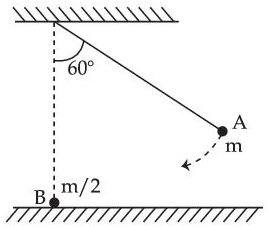
As shown below, bob A of a pendulum having massless string of length ‘R’ is released from $60^\circ$ to the vertical. It hits another bob B of half the mass that is at rest on a friction less table in the center. Assuming elastic collision, the magnitude of the velocity of bob A after the collision will be (take $g$ as acceleration due to gravity.)
Figure for the question
  1. A
    $\dfrac23\sqrt{Rg}$
  2. B
    $\dfrac13\sqrt{Rg}$
  3. C
    $\dfrac43\sqrt{Rg}$
  4. D
    $\sqrt{Rg}$
Q929 Jan 2025 · Shift 2MCQ
Given below are two statements. One is labelled as Assertion (A) and the other is labelled as Reason (R).
Assertion (A) :
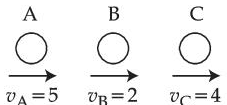
Figure for the question
Three identical spheres of same mass undergo one dimensional motion as shown in figure with initial velocities $v_A=5$ m/s, $v_B=2$ m/s, $v_C=4$ m/s. If we wait sufficiently long for elastic collision to happen, then $v_A=4$ m/s, $v_B=2$ m/s, $v_C=5$ m/s will be the final velocities.
Reason (R) : In an elastic collision between identical masses, two objects exchange their velocities.
In the light of the above statements, choose the correct answer from the options given below :
  1. A
    (A) is false but (R) is true
  2. B
    Both (A) and (R) are true and (R) is the correct explanation of (A)
  3. C
    Both (A) and (R) are true but (R) is NOT the correct explanation of (A)
  4. D
    (A) is true but (R) is false