JEE Main 2025 January Physics: Thermodynamics – Previous Year Questions
All 13 questions asked from Thermodynamics in JEE Main 2025 January Physics (22, 23, 24, 28 and 29 January, all shifts). This chapter is about 5.2% of the 250 Physics questions in the session: 11 single-correct (MCQ) and 2 numerical-value questions. Select an answer to attempt each question, and open “View solution” under it.
13questions
11MCQ
2numerical
5.2%of Physics paper
Topics asked in this chapter
Thermodynamic Variables & Entropy – 2 questions
Thermodynamic Processes & First Law – 10 questions
Heat Engines & Carnot Cycle – 1 question
Thermodynamic Variables & Entropy
Q122 Jan 2025 · Shift 2MCQ
Given are statements for certain thermodynamic variables,
(A) Internal energy, volume (V) and mass (M) are extensive variables.
(B) Pressure (P), temperature (T) and density ($\rho$) are intensive variables.
(C) Volume (V), temperature (T) and density ($\rho$) are intensive variables.
(D) Mass (M), temperature (T) and internal energy are extensive variables.
Choose the correct answer from the options given below :
A
(A) and (B) Only
B
(D) and (A) Only
C
(C) and (D) Only
D
(B) and (C) Only
Q223 Jan 2025 · Shift 2MCQ
Water of mass $m$ gram is slowly heated to increase the temperature from $T_1$ to $T_2$. The change in entropy of the water, given specific heat of water is $1\ \mathrm{Jkg^{-1}K^{-1}}$, is :
A
$m\ln\left(\frac{T_2}{T_1}\right)$
B
zero
C
$m(T_2 - T_1)$
D
$m\ln\left(\frac{T_1}{T_2}\right)$
Thermodynamic Processes & First Law
Q323 Jan 2025 · Shift 1MCQ
Match the LIST-I with LIST-II
LIST-I
LIST-II
A. Pressure varies inversely with volume of an ideal gas.
I. Adiabatic process
B. Heat absorbed goes partly to increase internal energy and partly to do work.
II. Isochoric process
C. Heat is neither absorbed nor released by a system.
III. Isothermal process
D. No work is done on or by a gas.
IV. Isobaric process
Choose the correct answer from the options given below :
A
A-I, B-IV, C-II, D-III
B
A-III, B-I, C-IV, D-II
C
A-III, B-IV, C-I, D-II
D
A-I, B-III, C-II, D-IV
Q423 Jan 2025 · Shift 1Numerical
An ideal gas initially at $0^\circ$C temperature, is compressed suddenly to one fourth of its volume. If the ratio of specific heat at constant pressure to that at constant volume is $3/2$, the change in temperature due to the thermodynamic process is K.
Q523 Jan 2025 · Shift 2MCQ
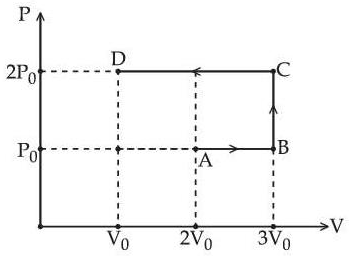
Using the given P-V diagram, the work done by an ideal gas along the path ABCD is :
A
$3P_0V_0$
B
$-3P_0V_0$
C
$4P_0V_0$
D
$-4P_0V_0$
Q624 Jan 2025 · Shift 1MCQ
An ideal gas goes from an initial state to final state. During the process, the pressure of gas increases linearly with temperature.
A. The work done by gas during the process is zero.
B. The heat added to gas is different from change in its internal energy.
C. The volume of the gas is increased.
D. The internal energy of the gas is increased.
E. The process is isochoric (constant volume process)
Choose the correct answer from the options given below:
A
A, D, E Only
B
A, B, C, D Only
C
E Only
D
A, C Only
Q724 Jan 2025 · Shift 1Numerical
The temperature of 1 mole of an ideal monoatomic gas is increased by $50^\circ$C at constant pressure. The total heat added and change in internal energy are $E_1$ and $E_2$, respectively. If $\frac{E_1}{E_2} = \frac{x}{9}$ then the value of $x$ is .
Q824 Jan 2025 · Shift 2MCQ
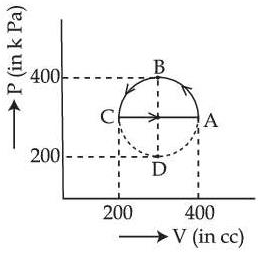
The magnitude of heat exchanged by a system for the given cyclic process ABCA (as shown in figure) is (in SI unit) :
A
$5\pi$
B
zero
C
$40\pi$
D
$10\pi$
Q924 Jan 2025 · Shift 2MCQ
Given below are two statements. One is labelled as Assertion (A) and the other is labelled as Reason (R).
Assertion (A) : In an insulated container, a gas is adiabatically shrunk to half of its initial volume. The temperature of the gas decreases.
Reason (R) : Free expansion of an ideal gas is an irreversible and adiabatic process.
In the light of the above statements, choose the correct answer from the options given below :
A
Both (A) and (R) are true and (R) is the correct explanation of (A)
B
(A) is false but (R) is true
C
(A) is true but (R) is false
D
Both (A) and (R) are true but (R) is NOT the correct explanation of (A)
Q1029 Jan 2025 · Shift 1MCQ
The workdone in an adiabatic change in an ideal gas depends upon only :
A
change in its specific heat
B
change in its pressure
C
change in its volume
D
change in its temperature
Q1129 Jan 2025 · Shift 2MCQ
Given below are two statements. One is labelled as Assertion (A) and the other is labelled as Reason (R).
Assertion (A) : With the increase in pressure of an ideal gas, the volume falls off more rapidly in an isothermal process in comparison to the adiabatic process.
Reason (R) : In isothermal process, $PV = $ constant, while in adiabatic process $PV^{\gamma} = $ constant. Here $\gamma$ is the ratio of specific heats, P is the pressure and V is the volume of the ideal gas.
In the light of the above statements, choose the correct answer from the options given below :
A
(A) is true but (R) is false
B
Both (A) and (R) are true and (R) is the correct explanation of (A)
C
Both (A) and (R) are true but (R) is NOT the correct explanation of (A)
D
(A) is false but (R) is true
Q1229 Jan 2025 · Shift 2MCQ
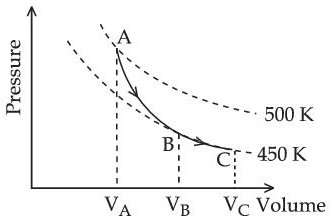
A poly-atomic molecule ($C_V = 3R$, $C_P = 4R$, where $R$ is gas constant) goes from phase space point $A(P_A = 10^5$ Pa, $V_A = 4\times10^{-6}\ \mathrm{m^3})$ to point $B(P_B = 5\times10^4$ Pa, $V_B = 6\times10^{-6}\ \mathrm{m^3})$ to point $C(P_C = 10^4$ Pa, $V_C = 8\times10^{-6}\ \mathrm{m^3})$. A to B is an adiabatic path and B to C is an isothermal path. The net heat absorbed per unit mole by the system is :
A
$500R(\ln 3 + \ln 4)$
B
$400R\,\ln 4$
C
$450R(\ln 4 - \ln 3)$
D
$500R\,\ln 2$
Heat Engines & Carnot Cycle
Q1328 Jan 2025 · Shift 1MCQ
A Carnot engine (E) is working between two temperatures 473K and 273K. In a new system two engines - engine $E_1$ works between 473K to 373K and engine $E_2$ works between 373K to 273K. If $\eta_{12}$, $\eta_1$ and $\eta_2$ are the efficiencies of the engines E, $E_1$ and $E_2$, respectively, then